

Enemy fire had hit the port-side stabilizer again.
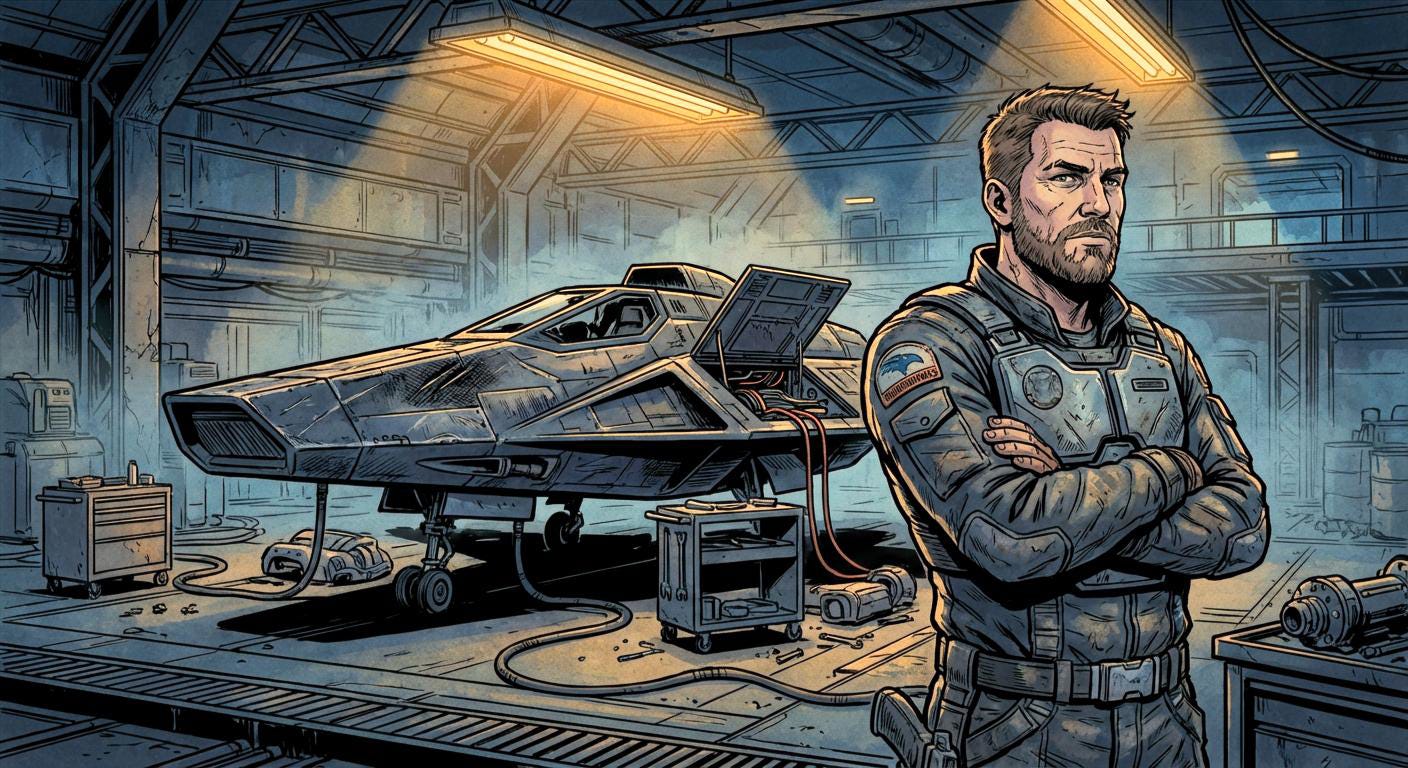
Kango Galyx stood in Hangar 7 of Aster Station with his arms crossed and his jaw set, staring at the Torino like a man staring at a bar tab he couldn’t afford. The ship sat on the deck with her canopy up and her guts showing, fuel lines snaking across the floor, a diagnostic cart plugged into her starboard access panel, and a scorch mark along the belly plating that hadn’t been there six hours ago.
Six hours ago, he’d been on patrol. Routine sweep of the shipping lanes between Aster and the Cutlass Belt. Four hours of nothing, which was the best kind of patrol, followed by two hours of everything, which was the worst.
“You’re lucky she’s still flying,” Albern said, the deck chief, from somewhere underneath the Torino’s port wing. All Kango could see were boots and a tool belt. “That stabilizer coupling is hanging on by spite and solder.”
“She got me home.”
“She got you home this time.” Albern rolled out on his creeper, face smeared with hydraulic fluid, and pointed a wrench at Kango the way a doctor points a finger at a patient who won’t quit smoking cinder sticks. “Next time that coupling fails mid-burn, you’re going to spin into whatever you’re trying not to hit. And I’m going to have to fill out the reports.”
“Your concern is touching.”
“My concern is for the reports.” Albern rolled back under the wing. “Gonna need five hours. Minimum.”
Kango checked the clock on the hangar wall: 1847 station time. He’d filed his patrol report before he’d even popped the canopy, still smelling like coolant and adrenaline. The details were already turning into the flat language of after-action documentation. Three contacts. Unregistered. Raider-class vessels running dark in the Cutlass approach corridor, engines cold, waiting in the asteroid shadow like mines in a shipping lane.
He hadn’t seen them until they lit up.
The first one had come in fast and stupid, which was how you could tell they were new to the trade. Pirate raiders who’d been at it a while knew the advantage of ambush was patience. You waited for the target to commit to a vector, then you cut off the escape route before you opened fire. The geometry mattered more than the guns.
This crew skipped the geometry. The lead ship broke from the asteroid cluster at full burn, weapons hot, closing on a freight hauler lumbering through the corridor with a belly full of ore concentrate bound for the Aster refineries. The hauler saw them coming and did what haulers do: panicked, dumped thrust, and started screaming on the open channel.
Kango was eleven clicks out when the distress call hit. He was supposed to radio Aster Station, request authorization, and wait for a tactical assessment. That was the protocol. The protocol assumed that the freighter had eleven clicks worth of time, which it did not.
He pushed the Torino to full military power and went in alone.
The lead raider didn’t see him until he was inside weapons range. The Torino was small, fast, and running a low-emission profile that made her hard to pick up against the background radiation of the Belt. Kango came in on an intercept angle that put the lead raider between him and the freighter, which meant the raider couldn’t fire back without risking a miss that would hit the prize they were trying to steal.
He put two cannon bursts into the lead ship’s engine housing. Clean shots. The first one cracked the shielding. The second one found the power coupling underneath, and the raider’s engines went dark in a shower of sparks and venting atmosphere. Dead in space. The crew would live if they had suits and someone came for them before the air ran out. That was their problem.
The second raider was smarter. It broke off the hauler and came around hard, trying to get behind him. Kango had expected that. He’d been flying combat patrols on the frontier for nine years, and the one thing he’d learned about pirates was that they always thought they were more clever than they were. They watched too many war vids. They thought dogfighting was about reflexes and aggression. It wasn’t. It was about energy management and knowing your ship better than the other pilot knew theirs.
He cut thrust, rotated the Torino on her axis, and let the second raider fly into his targeting solution. The pilot realized the mistake too late. Kango watched the raider try to break off, engines flaring, and he put a burst across the bow. Warning shots. Close enough to rattle the hull.
The raider broke and ran. Full burn toward the Belt, engines screaming, running for the cover of the asteroid field where a single fighter couldn’t follow without risking a collision every six seconds.
That left the third one.
This raider had done everything right. While the first two made noise and drew attention, the third had swung wide, running silent on a long arc that brought it around behind the hauler on the opposite side. No engine signature. No weapons charge. Just a ghost drifting through the void, using the chaos as cover.
Kango didn’t notice the parasite until it had already latched onto the hauler’s cargo module.
A boarding clamp. Magnetic. The ship had matched velocity with the hauler and grafted itself to the hull, and now there were people with guns cutting through the skin into the cargo bay. The hauler’s captain shouted on the comm something about armed intruders and a request for immediate help. Kango was available with two pulse cannons and no way to use them without killing everyone involved.
He parked the Torino two hundred meters off the freighter’s bow and thought about it.
The math was ugly. He couldn’t shoot the parasite off the hull. He couldn’t board the freighter himself because the Torino was a single-seat fighter with no airlock. And he couldn’t wait for backup because the nearest patrol was forty minutes out and the pirates would be gone in ten.
So he did the thing that wasn’t in any manual.
He opened a direct channel to the raider. Tight beam. Private.
“This is Lieutenant Kango Galyx, Frontier Patrol, operating under Aster Station authority. You’ve got about ninety seconds to detach from that freighter and power down your weapons.”
A pause. Then a voice came back, male, young, words tumbling out too fast. “Yeah, no, that’s not how this works, Patrol. We’re clamped to sixty tons of ore and a crew of nine, so unless you’re planning to vaporize all of them to get to us, I’d suggest you find somewhere else to be.”
“You’re right,” Kango said. “I can’t shoot you. But here’s what I can do. I’ve got your drive signature on record from your approach. Silent running doesn’t mean invisible. It means quiet. I’ve tracked you for the last six minutes. Which means I’ve got your engine profile, your emissions pattern, and your vector when you bug out. The moment you detach, every patrol ship and station gun in this sector will have your signature. You won’t make it far.”
Silence on the channel.
“Your buddy in raider two is already running for the rocks,” Kango said. “Raider one is dead in space with no engines. You’re the last one, and you’re stuck to the side of a freighter with a patrol fighter parked on your nose. Think about your next move.”
More silence.
“Ninety seconds was generous. You’ve got sixty now.”
“That’s—” A pause. Too long. “You’re bluffing.” But the bravado had curdled into something thinner.
“Detach and power down. I’ll let you keep your ship. Stay latched, and I’ll call in the heavy patrol, and they don’t ask politely.”
Thirty seconds of silence. Kango watched the raider’s systems on his scope. The boarding clamp disengaged. The raider’s engines lit up with low power, maneuvering only. It drifted away from the freighter’s hull and departed the area, weapons cold, running lights on.
Kango exhaled.
“Smart choice,” he said.
The freighter captain bought him a drink over comms, which was the frontier equivalent of a handshake. The heavy patrol arrived thirty-eight minutes later and took custody of raider one, still drifting dark with dead engines. Raiders two and three were long gone, swallowed by the Cutlass Belt. But every database from Aster to the Cutlass stations had their signatures flagged. They’d surface eventually. They always did.
Now Kango stood in Hangar 7, arms crossed, watching Albern work on the stabilizer that had taken a glancing hit from raider two’s parting shot. A gift. A reminder that smart wasn’t the same as safe.
“Five hours?” he said.
“Minimum,” Albern said from under the wing.
Kango looked at the Torino. She was twelve years old, six years past her recommended service life, patched and re-patched and held together by the accumulated stubbornness of every mechanic who’d ever refused to let her die. The hull plating didn’t match. Mechanics salvaged the port cannon from a decommissioned bomber. And the ejection seat had a manufacturer’s warranty that had expired before Kango had graduated from flight school.
She was the best ship he’d ever flown. Not because she was fast or tough or well-armed, although she was all three when she felt like it. Because she always brought him home. Even when home was a station at the edge of nothing, surrounded by dark and pirates and the vast indifference of a frontier that didn’t care whether you lived or died.
He uncrossed his arms and walked to the tool cart.
“What are you doing?” Albern said.
“Helping.”
“You’re a pilot.”
“And she’s my ship.”
Albern was quiet for a moment. Then: “Grab the number four wrench. And don’t touch the plasma conduits.”
Kango grabbed the wrench. The hangar lights buzzed overhead. Somewhere in the Belt, two raiders ran for cover, and the freight lanes were quiet again, at least for tonight.
Tomorrow there’d be another patrol. Another sweep. Another four hours of nothing, if he was lucky.
He was rarely lucky. But the Torino was stubborn, and that was close enough.


