

Outrider Echo cooled on Landing Pad Nine like an old dog settling into a familiar spot. Her hull ticked and pinged as the metal contracted, shedding the heat of atmospheric entry. Around her, the Kaeloni Reach spaceport hummed with the low, steady noise of a place that never fully slept. Fuel haulers crawled between ships, and dockworkers shouted over the whine of cargo loaders. Beyond the floodlights and in the darkness, music bled out of a bar that didn’t bother with a sign because everyone who needed to find it already knew where it was.
Finn Silver sat on a cargo crate in the open bay of the ship, legs dangling, watching it all.
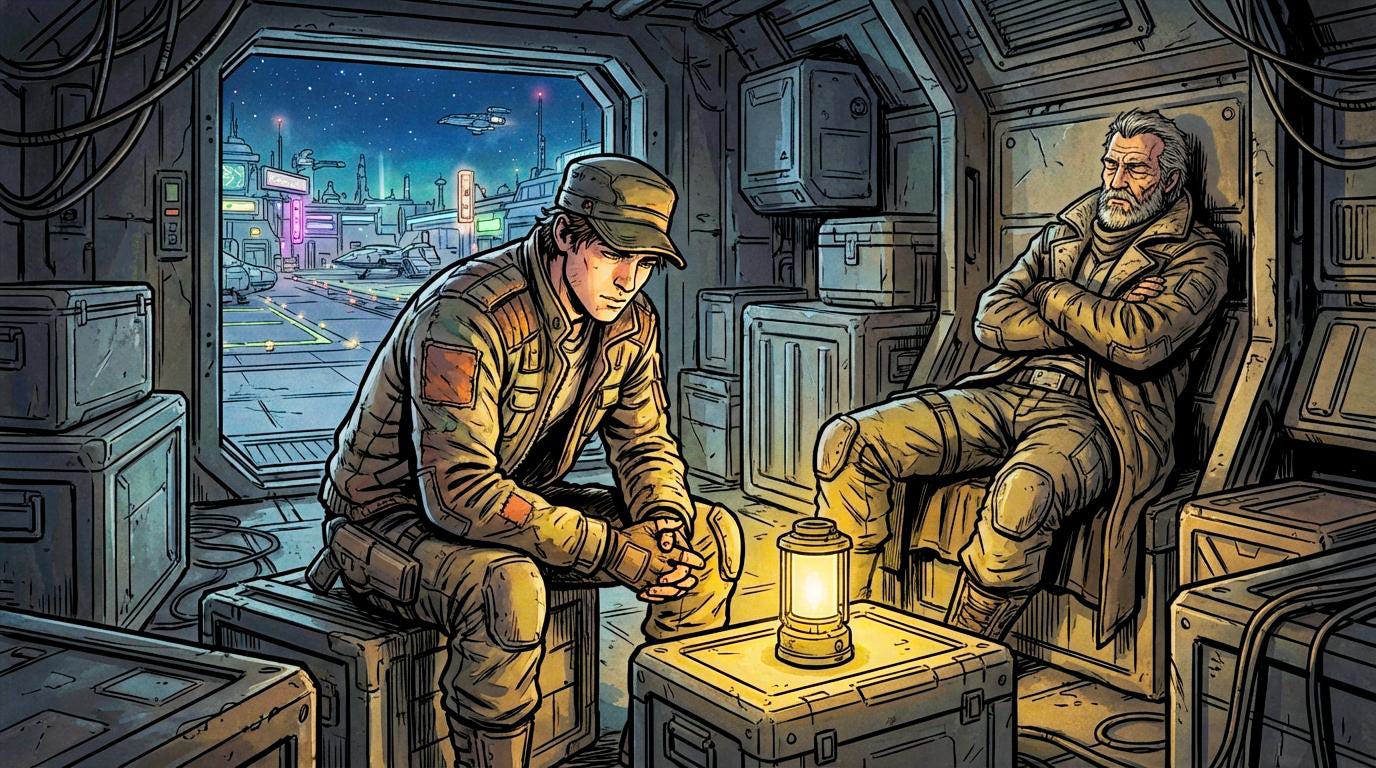
He was twenty-three but looked younger. Brown jacket, cap pulled low, boots that were too new for the frontier. His posture looked as if he were waiting for something to happen, leaning forward with his elbows on his knees and his hands clasped, like a kid sitting outside the principal’s office. He’d crewed with Crank for six weeks now, and in those six weeks he’d learned how to load cargo, cycle an airlock, and keep his mouth shut when port authorities came asking questions.
He had learned little else. Not because Crank wouldn’t teach him. Because Crank didn’t seem to care.
Rafferty “Crank” Jack approached the ship. His boots sounded on the ramp as he walked into the cargo bay, carrying a small supply crate under one arm and a bottle of Kaeloni rye in his free hand. The outlaw was in his late fifties, gray in the beard, heavy in the shoulders, wearing the same faded jacket he’d worn every day since Finn had met him. He set the crate down without ceremony, dropped into the fold-out chair across from Finn, and cracked the bottle.
He didn’t offer any.
“Port boss says we can hold the pad through zero-eight-hundred,” Crank said. He took a long pull from the bottle and stared at the far wall of the cargo bay. “After that, it’s double rate.”
“What’s the next job?” Finn asked.
“There’s always a next job.”
“That’s not an answer.”
“It’s the only one I’ve got, Jinx.”
Finn’s jaw tightened at the name. He’d told Crank a dozen times his name was Finn, and a dozen times Crank had ignored him. Jinx. Like he was a curse. Like everything he touched went sideways. Crank had pinned it on him the first week after Finn knocked over a fuel canister during a supply run and nearly set fire to a docking cradle on Verathi Station. The name stuck because Crank wanted it to, and what Crank wanted on his own ship was what happened.
They sat in silence. The lantern between them cast a warm light upward, leaving their faces half-shadowed. Outside, a loading crane groaned, and someone argued about docking fees in two languages. Inside Outrider Echo, it was still.
A girl, maybe twelve or thirteen, appeared from around the ship and stood at the foot of the loading ramp with a tray of food packets balanced on one arm. Her thin, dusty clothes held a variety of patches, creating a mystery around the garment’s original fabric. One of the port kids. Every frontier spaceport had them. Orphans, runaways, station rats who survived by selling food, running errands, or stealing what they couldn’t sell.
“Rations?” she asked. “Fresh today. Five Geld each.”
Crank didn’t look up. “Get lost.”
Finn reached into his jacket. He pulled out a ten-Geld coin, more than he should have spent, and held it out. “I’ll take two.”
The girl climbed halfway up the ramp, handed him two packets, and took the coin. She glanced at Crank, then back at Finn. Her fingers closed around the coin fast, holding it like something she was afraid someone would take back. She looked at Finn for half a second longer than she needed to and dropped her eyes.
“Thanks, mister,” she said, and disappeared into the spaceport dark.
Finn tossed one packet to Crank. It landed on the supply crate next to his bottle. Crank looked at it, then at Finn.
“You just spent ten Geld on ration packs worth two.”
“She needed it more than I did.”
“That’s a fine attitude until you’re broke and hungry on a station that doesn’t hand out charity.” Crank picked up the packet, turned it over, and set it back down. “You keep that up, Jinx, and the frontier will eat you alive.”
“Stop calling me that.”
“Stop earning it.”
Finn stood up. Not angry, but something close. He walked to the edge of the cargo bay where the ramp met the spaceport ground and looked out at Kaeloni Reach. The floodlights made hard shadows between the ships, people moving in and out of them. Everyone here was running from something or toward something, and most of them couldn’t tell you which.
“Why do you do this?” Finn said.
“Do what?”
“All of it.” Finn turned around. “The jobs. The running. Living out of this ship like it’s a coffin with an engine.”
“Watch your mouth about my ship.”
“I’m serious. Why?”
Crank took another drink. A long one. He set the bottle down and leaned back, arms crossed, the way he always sat when he didn’t want to deal with something. Finn had seen that posture a hundred times in six weeks. It meant the conversation was over.
Except this time, Crank didn’t let it end.
“Because I was good at it,” he said. Quiet. Not proud. Just factual, like reading a manifest. “I was twenty-two when I ran my first job. Cargo boost off a supply transport near the Pellion corridor. Clean work. In and out. Nobody got hurt, and I walked away with more money than my father made in a year hauling freight.” He paused. “I thought that meant something.”
“Didn’t it?”
“It meant I was good at stealing.” Crank’s voice flattened. “That’s all it meant. But when you’re twenty-two and you’re good at something, you don’t ask whether you should do it. You just keep going. And then it’s been thirty years and you’re sitting on Kaeloni Reach wondering when exactly you stopped choosing this life and started just living it because you didn’t know how to do anything else.”
The lantern flickered. A fuel hauler rumbled past outside, shaking the deck plates.
Finn said nothing. He didn’t need to. He came back and sat down.
Crank stared at the bottle in his hand. “You want to know why I call you Jinx?”
“Because I knocked over that fuel canister.”
“No.” Crank set the bottle down. “Because every time I look at you, I see the version of me that I should have walked away from thirty years ago. And I didn’t. And that’s bad luck, kid. The worst kind. The kind you do to yourself.”
Silence followed, longer than before.
Finn looked at his hands. “I wasn’t always like this,” he said. “Kind. Or whatever you want to call it.”
Crank raised an eyebrow.
“I hurt someone,” Finn said. “Back on Verata Prime. I was running with a crew there. Small-time stuff. Smash and grab, supply raids. I was good at it, too.” He paused. “We hit a transport that was supposed to be empty. It wasn’t. There was a family inside. A man, his wife, and two kids. The crew didn’t care. They took what they wanted and left those people in a stripped transport with no power and half a day of air.”
“What did you do?” Crank said.
“I went back.” Finn’s voice held steady, but his hands shook. “After the crew split up, I took my cut, bought a fuel cell, and went back. Got their power online. Made sure they could reach the nearest station.”
“And the crew?”
“They found out. I left that night. Haven’t been back.”
Crank studied him. Not the quick, dismissive glance he usually gave the kid. A long, careful look, the kind he used to give a cargo manifest when the numbers didn’t add up.
“That’s why you came looking for me,” Crank said. “You thought a different crew would be different.”
“I thought you’d teach me how to do this without hurting people.”
“You can’t do this without hurting people, Finn.” It was the first time Crank had used his real name. “You can tell yourself the targets deserve it. You can pick your jobs careful and sleep clean at night for a while. But eventually someone’s in the wrong place, or the intel’s bad, or you’re tired and you cut a corner. And then there’s a family in a stripped transport with half a day of air, and you’re the reason.”
Crank picked up the ration pack Finn had tossed him. He turned it over in his hands.
“You went back for them,” he said. “In thirty years, I never went back for anyone.”
The spaceport noise filled the gap between them. Engines warming up on a nearby pad. A dockworker cursing. The faint melody of that unseen bar.
“Get off my ship,” Crank said.
Finn blinked. “What?”
“You heard me.” Crank’s voice was rough, but there was no anger in it. If anything, it sounded like something closer to kindness than Finn had ever heard from the man. “This isn’t your life. It was never your life. You came out here looking for a way to be what you already are, and the answer isn’t on this ship.”
“Crank...”
“Rafferty.” The old man looked at him. “My name is Rafferty. And I’m telling you to go. Not because you’re bad luck. Because you’re the only good thing that’s walked up that ramp in thirty years, and if you stay, this life will grind it out of you the way it ground it out of me.”
Finn sat still for a long time. The lantern buzzed and flickered between them. Outside, a ship lifted off from a nearby pad, the engine wash rattling Outrider Echo’s hull plates.
He stood up.
“What about you?” Finn said.
Crank opened the ration pack and took a bite of smoked synth- protein. He chewed slowly, staring at the open cargo door and the spaceport beyond it. The same view he’d been looking at for thirty years. Pads and ships and floodlights and the dark.
“I’ll figure that out,” he said. “Get going.”
Finn walked down the ramp. His boots hit the spaceport tarmac, and the sound differed from what it had been six weeks ago. Heavier. More certain.
He stopped at the bottom and looked back. Crank remained in the chair, arms crossed now, silhouette framed by the warm light of the lantern. He looked the same as he always did. Except he didn’t, not really. His jaw had unclenched and his shoulders had dropped, as if he no longer carried a heavy weight.
Finn turned and walked into Kaeloni Reach, past a fuel crew dragging hoses between pads and a pair of hauler pilots splitting a cinder stick under a landing strut. He didn’t know where he was going. He didn’t need to. The frontier was big, and somewhere in it was a place for a man who went back for people.
He thought about the name. Jinx. He’d hated it for six weeks. Hated what it meant, hated the dismissal baked into it, hated that Crank couldn’t be bothered to call him by his real name.
But Crank called him Finn tonight. Just once. And it was enough.
Jinx was someone else now. He’d walked onto that ship and made an old man look in the mirror. If that was bad luck, fine. Crank could call it whatever he wanted.
Yeah, Finn thought. Jinx works.
He pulled his cap low and kept walking. Behind him, inside Outrider Echo, Rafferty Jack stared at the open door and ate a ration pack a kid had overpaid for.
On the frontier, every signal tells a story. This one said: it’s never too late to change direction.


