
The Plane That Vanished
A Cold War Mystery I Discovered While Writing My Next Book

Sometimes the best stories find you while you’re researching someone else’s…
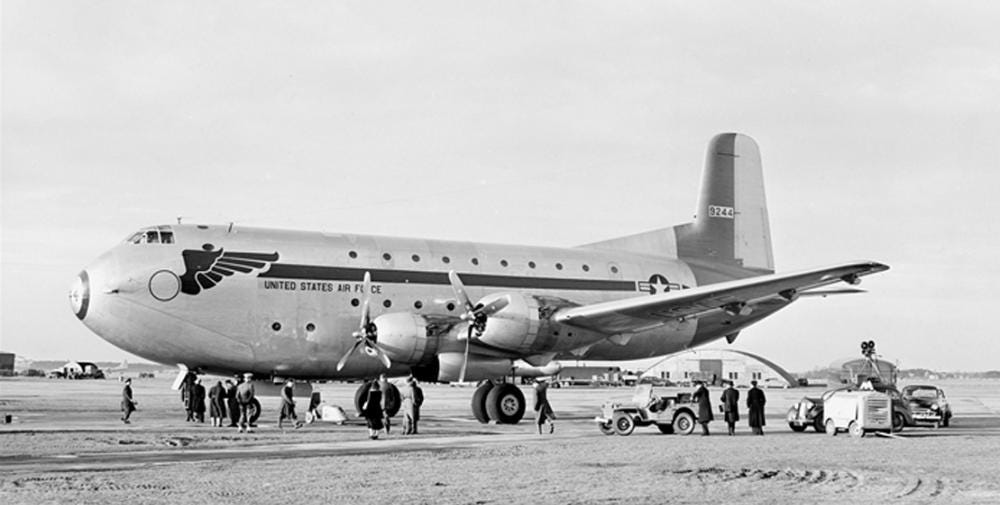
I’m deep into research for Blood Wing, the second Jack Morrison’s Blood & Bourbon Mystery Files novella right now. The new book is set in early 1951 at the Douglas Aircraft Company plant in Long Beach, California, the massive facility where America built some of its most important military aircraft during the Korean War. Morrison’s case takes him inside that plant, so I’ve been doing what any writer of historical fiction should do: digging into what actually happened there, on those assembly lines, at that airfield, in that specific window of time.
That’s when I found the story of Aircraft 49-0244.
And it stopped me cold.
What They Built in Long Beach
The Douglas Aircraft plant in Long Beach was one of the great industrial engines of World War II and the Cold War. Among the aircraft rolling off those assembly lines in 1950 and 1951 was the C-124 Globemaster II, a massive heavy-lift cargo plane that the crews who flew it nicknamed “Old Shaky” for the constant vibrations, creaks, and groans it produced in flight. It was the largest operational cargo aircraft of its era, capable of carrying tanks, bulldozers, and up to 200 fully equipped troops. First deliveries began in May 1950, and the planes went straight into service during the Korean War.
The C-124 was built to carry anything, anywhere. It had clamshell doors in the nose, hydraulic ramps, and an elevator under the aft fuselage. It was the backbone of America’s strategic airlift capability at the height of Cold War tension.
One of those planes, a C-124A, tail number 49-0244, would become the center of one of the most baffling military aviation mysteries in American history.
March 23, 1951: Good Friday
On March 21, 1951, C-124A number 49-0244 departed Walker Air Force Base in Roswell, New Mexico, on what was described as a routine military transport flight. The aircraft belonged to the 2nd Strategic Support Squadron of the Strategic Air Command. Its destination: RAF Mildenhall in Suffolk, England, with a stopover at Limestone Air Force Base in Maine.
The plane was carrying 53 people, 13 crew members and 40 passengers. This was no ordinary passenger manifest. Among those aboard were flight crews from the 509th Bombardment Group, America’s first-strike nuclear bomber force, along with personnel from the 28th Fighter Squadron and 69th Ordnance Company. The highest-ranking person on the flight was Brigadier General Paul Thomas Cullen, who had directed photographic operations during nuclear bomb tests at Bikini Atoll and served as commander of the 7th Air Division.
The transatlantic leg of the flight proceeded normally. The Globemaster checked in routinely with weather ships stationed across the Atlantic. Then, in the early hours of Good Friday, March 23, 1951, the crew sent what would be their last routine message to Oceanic Control, updating their estimated time of arrival. No problems reported.
What happened next changed everything.
At approximately 1300 hours, the C-124 crew transmitted a Mayday distress call to the weather ship USCGC Casco, reporting a fire in the cargo crates. The crew jettisoned burning cargo and announced they prepared to ditch the aircraft in the Atlantic, roughly 700 miles southwest of Ireland.
The Ditching
Here’s where the story shifts from emergency to mystery.
The crew executed a controlled ditching into the North Atlantic. The aircraft remained intact on the water. All 53 people aboard exited wearing life preservers and climbed into inflated five-man life rafts equipped with cold-weather gear, food, water, flares, and hand-crank emergency radios.
They had survived the crash. They were in the rafts. They had supplies.
A B-50 Superfortress dispatched from RAF Lakenheath reached the ditching coordinates and made visual contact with the survivors. The crew of the search aircraft saw the rafts. They saw flares the survivors had ignited. They confirmed the location and reported it. But the B-50 was running low on fuel and had to return to base.
As of that moment, 53 men were alive in the North Atlantic, their position known, rescue on the way.
The Disappearance
When the Coast Guard Cutter Casco arrived at the ditching coordinates on March 24, 1951, roughly 19 hours after the survivors had been spotted, the men were gone. The aircraft was gone. The life rafts were gone.
All that remained was some charred plywood and a single briefcase.
The Casco was joined by British aircraft, weather ships, a submarine, and several warships, including the aircraft carrier USS Coral Sea. They conducted an extensive multi-day search covering hundreds of square miles of the North Atlantic.
They found nothing. Not a single body. Not a life raft. Not a piece of wreckage beyond those few scraps.
Fifty-three men, confirmed alive in rafts, spotted by a search aircraft, their flares visible, had simply vanished.
The Questions That Won’t Die
The official conclusion attributed the disappearance to the harsh conditions of the North Atlantic in late March, such as cold water, rough seas, and the heavy C-124 airframe sinking. But that explanation has never satisfied everyone, and for good reason.
The survivors were seen alive in rafts with supplies and cold-weather gear. The position was confirmed visually by a search aircraft. And yet a massive, multi-national search and rescue operation recovered virtually nothing. Not even bodies.
Over the decades, theories have circulated. Soviet submarines were known to have been operating in the area. Given the extraordinary intelligence value of the passengers, including nuclear-cleared bomber crews and a brigadier general with direct knowledge of atomic weapons testing, speculation about Soviet involvement has persisted. The cargo manifest has also raised questions. The C-124 routinely transported missiles and weapons between the United States and England, and some family members of the lost crew have publicly stated their belief that the aircraft was carrying nuclear-related material.
Freedom of Information Act requests filed by surviving family members to the CIA, State Department, and Air Force have reportedly been met with resistance. Family members have described being stonewalled for decades, with relevant documents classified, declassified, and reclassified multiple times.
It would take more than 60 years before any formal recognition came. In 2012, two of the lost airmen, Captain Walter Thomas Peterson and Lawrence Rafferty, were finally honored with cenotaphs at Arlington National Cemetery. Additional ceremonies followed in subsequent years. There are no graves. There are no remains. Just markers for men whose fate remains officially undetermined.
Why This Matters to a Noir Writer
I didn’t set out to find this story. I was researching the history of the Douglas Aircraft plant circa 1951. I needed to understand the world Jack Morrison and my other fictional characters would inhabit. The C-124 was part of that world. It was being built on the same assembly lines, at the same airfield, by the same workers who populate the pages of my next noir thriller.
And there it was. A real mystery wrapped inside the history I was already excavating.
This is one of the things I love about writing historical fiction. You go looking for the texture of a specific time and place, and the history hands you something you never expected. A story that reads like fiction but isn’t. A disappearance that has no satisfying resolution. An ending where the truth stays classified and the families are left with markers over empty ground.
If that doesn’t sound like noir, I don’t know what does.
The C-124 disappearance doesn’t appear directly in my new book. But it hangs over the setting the way a ghost story hangs over a house. The workers at Douglas Aircraft in early 1951 would have known about it. They built that plane. Their hands riveted its skin and wired its systems. And then it swallowed 53 men and the ocean swallowed the evidence.
For a series built on the idea that justice is incomplete and truth gets buried by the institutions that should protect it, I couldn’t have invented a more fitting piece of historical background.
Sometimes the research teaches you more than you expected. Sometimes it reminds you why you write what you write.
Blood Wing, the second Jack Morrison novella is in progress. More details coming soon but expect publication in late April/early May 2026.
If you haven’t read the first entry, Blood Tide: A Harbor Noir Thriller is available now.
Daniel P. Douglas writes noir fiction set in 1950s Los Angeles and Southern California. His series, Jack Morrison’s Blood & Bourbon Mystery Files, follows an ex-LAPD detective through cases where corruption is systemic, justice is incomplete, and the only certainty is that somebody’s going to bleed.
It would take some work but I wonder if there's anything in the soviet archives.
Sounds interesting