

Beat the Log, Get the Goods
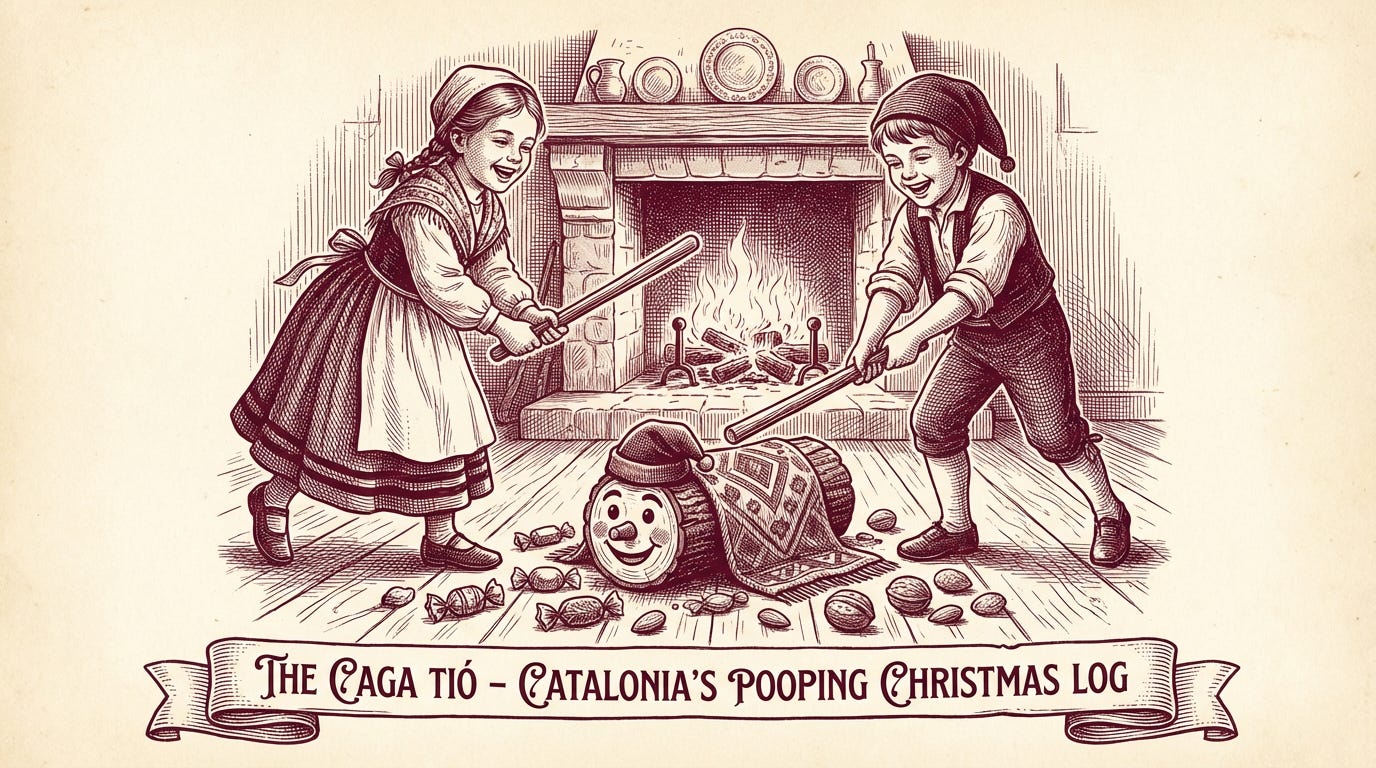
It’s Christmas Eve in Catalonia, Spain. A family gathers around a small wooden log with a painted face and a red hat. The log has a blanket over it. The children pick up sticks.
Then they start beating the log. Hard. While singing.
“Poop, log! Poop out nougat! Poop out presents! If you don’t poop well, I’ll hit you with a stick!”
They lift the blanket. Candy and small gifts have appeared underneath. The log has “pooped” out Christmas presents.
This is Caga Tió. The pooping log. Millions of people have been doing this since at least the 1600s. That’s over 400 years of beating a log until it poops.
You’re reading “Wait, That Actually Happened?” where we prove history is stranger than fiction. Today we’re talking about a Christmas tradition that’s been going strong since the 17th century. An entire region of Spain decided the best way to celebrate the holidays was to beat a log until it poops.
Merry Christmas from Catalonia!
Catalonia’s Bathroom-Themed Holiday Season
Okay, I know I said last time that we’d be talking about the CIA’s Project Acoustic Kitty, but hey, Christmas is next week, so I changed my mind. If you’re dying to learn more about spying cats, and I mean, who doesn’t, right? Well then, check out my Declassified series for both a podcast and article on that exact subject.
Now, back to pooping logs...
Okay, so Catalonia is a region in northeastern Spain with Barcelona as its capital. Catalan people have their own language, their own culture, and their own very unique Christmas traditions.
The Caga Tió, which literally translates to “pooping log” or “pooping uncle,” became popular during the 17th and 18th centuries. That’s the 1600s and 1700s. But its roots go back even further, probably to ancient pagan winter solstice rituals.
See, before Christianity came to Europe, people celebrated the winter solstice. The shortest day of the year. They burned logs as symbols of light returning to the world. Many cultures had special Yule logs that they’d burn for good luck. The French had a tradition of burning a Christmas log mentioned in documents from the 1700s.
But somewhere along the way, Catalonia looked at this tradition and thought, “You know what would make this better? If the log pooped.”
Originally, the Tió was just a plain piece of wood. Families would burn it from Christmas Day until the Feast of the Epiphany on January 6th. They’d spread the ashes on their fields and in their stables, believing it would bring a good harvest and healthy animals.
But by the 1700s, the tradition shifted. Instead of burning the log for blessings, families started making it “give back” to the children. The log gained a painted face, a red hat, and little stick legs. It became a character. A character that poops presents.
And honestly? That tracks. Because Catalonia has a whole thing about poop at Christmas.
I’m not kidding. They also have the Caganer, which is a little figurine of a person pooping that they hide in their nativity scenes. Every nativity scene. Baby Jesus, Mary, Joseph, the wise men, and somewhere in the corner, a guy with his pants down doing his business.
They’ve been doing this since at least the 1700s. The Caganer is seen as good luck because the poop “fertilizes the soil” and guarantees a good harvest. Today, you can buy Caganer figurines of famous people. Soccer players, politicians, celebrities. All squatting. All pooping. All watching over baby Jesus.
So the pooping log? That’s just the start of Catalonia’s bathroom-themed holiday season.
The Care and Feeding of Your Pooping Log
So here’s how Caga Tió works, and this ritual has stayed pretty much the same since the 1700s.
Starting on December 8th, the Feast of the Immaculate Conception, families bring out their Tió. It’s a small hollow log, usually about a foot long, propped up on two or four little stick legs. It has a painted face with a big smile. It wears a traditional red Catalan hat called a barretina. It looks like a very happy cartoon log.
For the next two weeks, the children of the family have to take care of the log. They cover it with a blanket to keep it warm. And every night, they “feed” it.
They leave out scraps of food, orange peels, bread crusts, whatever they can find. In the morning, the food is gone. The parents have secretly taken it away, of course. But the kids think the log is eating.
They’re fattening up the log. Like a Christmas turkey. Except instead of eating the log, they’re going to make it poop.
Then comes Christmas Eve, or sometimes Christmas Day. The big moment.
The whole family gathers around the Tió. They put a blanket over it so you can’t see what’s underneath. The kids grab sticks. And then they start beating the log while singing a special song.
There are lots of versions of the song, but they all have the same basic message. One popular version, translated from Catalan, goes:
“Poop, log, Christmas log, don’t poop herrings, they’re too salty, poop nougat, it’s much better!”
Another version threatens the log: “If you don’t poop well, I’ll hit you with a stick!”
The kids really go at it. They’re whacking this smiling log with sticks while demanding it poop out candy. And the whole family is singing along and laughing.
After a few rounds of the song, someone lifts the blanket. And there, underneath the log, are presents! Candy, nougat called turró, small toys, whatever the parents have secretly placed there.
The log has pooped.
But wait, there’s more. The kids put the blanket back down and beat the log again. More singing. More demanding poop. They lift the blanket. More presents! This goes on until the log is “empty.”
How do you know the log is empty? Traditionally, the final “gift” is something gross or silly. A head of garlic. A herring. An onion. Some families have the log poop out a fake piece of poop as the final item.
That’s when you know the Caga Tió is done pooping for the year.
From Fireplace Fuel to Cultural Icon
So what happens to the log after Christmas?
In the old days, back in the 1600s and 1700s, families would burn the Tió in the fireplace. The log that pooped out their presents becomes the fire that keeps them warm. It’s the circle of Christmas log life.
Some families saved the ashes and spread them in their garden for good luck, a holdover from the original pagan tradition. Others keep the log and reuse it next year. After all, a good pooping log is hard to find.
Today, Caga Tió is bigger than ever. You can buy pre-made Tiós at markets all over Catalonia. The Fira de Santa Llúcia in Barcelona has been selling them since 1786. They come in all sizes, from tiny decorative ones to giant logs for public celebrations.
Barcelona and other Catalan cities set up huge community Tiós in public squares. We’re talking logs the size of cars. Hundreds of children line up to beat the giant pooping log together.
The tradition has also spread beyond Catalonia. You can find Caga Tiós in Aragon, Andorra, and parts of southern France. Catalan immigrant communities around the world keep the tradition alive. There are Catalan families in New York, London, and Sydney all beating logs on Christmas Eve.
Catalonia is fiercely proud of this tradition. It’s part of their identity. When outsiders learn about it and react with confusion, Catalans just shrug. “What? Your Christmas log doesn’t poop?”
The pooping log has become a symbol of Catalan culture itself. It’s weird, it’s unique, and it makes no apologies for being different.
Santa vs. The Pooping Log
You know what’s funny? The pooping log actually makes more sense than some of our traditions.
Think about it. We tell kids that a large man breaks into our house through the chimney, eats our cookies, and leaves presents. That’s just as weird as a pooping log when you really think about it.
At least with Caga Tió, kids earn their presents. They have to feed the log for weeks. They have to take care of it. And then they physically work to get their gifts by beating it with sticks.
There’s something honest about it. You want presents? Work for them. Feed this log, then beat the candy out of it. It teaches kids that good things come to those who put in the effort.
Today, the pooping log has gone viral online. Every December, videos of confused tourists discovering Caga Tió spread across social media. People can’t believe it’s real.
But millions of Catalans have grown up with this tradition for over 300 years. To them, it’s as normal as hanging stockings or decorating a tree. It’s just what you do at Christmas. You feed a log, beat it with sticks, and make it poop out candy. That’s how holidays work.
Pitching the Pooping Log in 2025
Imagine if someone tried to invent the pooping log today.
“Okay, hear me out. For Christmas, we’re gonna have kids beat a piece of wood with sticks while singing about poop.”
“That’s... that’s the pitch?”
“Wait, there’s more! Before that, they feed it for two weeks. Like a pet. A pet log.”
“And what does the log do?”
“It poops out their presents.”
“Uhh…”
“Also, we put a little hat on it.”
Twitter-X would have a field day. Parents would call it inappropriate. Someone would write a think piece about “teaching children violence toward wood.” There’d be a petition to ban it.
But Catalonia has been doing this since the 1600s. By the time anyone thought to complain, the pooping log was already a beloved tradition with 400 years of history. You can’t cancel something that’s been pooping out presents since before your great-great-great-great-grandmother was born.
The Circle of Christmas Log Life
So that’s Caga Tió, the pooping log of Catalonia. A tradition that started as a pagan winter solstice ritual, evolved into a gift-giving custom in the 1700s, and has been going strong ever since. Families spend two weeks feeding a log, then beat it with sticks on Christmas Eve while singing about poop until it produces candy.
It’s weird. It’s wonderful. And it proves that every culture finds its own special way to celebrate holidays.
Merry Christmas and happy holidays from “Wait, That Actually Happened?” Whether you celebrate with a pooping log, a home-invading gift man, or something else entirely, I hope your season is full of surprises. May the New Year bring you many blessings.
Be sure to check out my Substack (Intelligence Bulletin from Author Daniel P. Douglas) for more podcast series, written articles, and links to my books. Thanks for listening!
Until then, remember: truth is stranger than fiction, and history is weirder than you think.