
Operation Sea-Spray
When the Navy Sprayed San Francisco with Bacteria

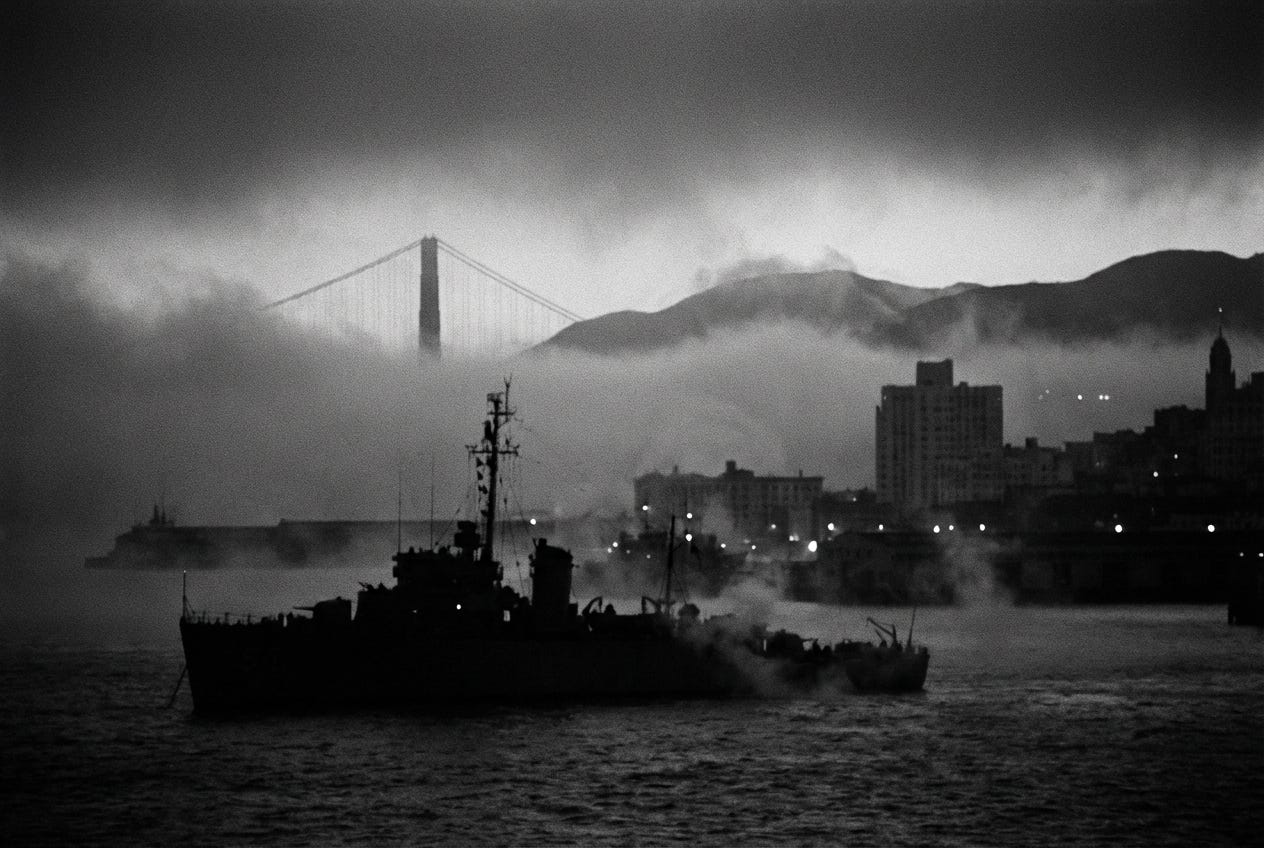
The Autumn Fog of 1950
The fog rolled in from the bay that October, thick, gray, and cold. It crept through the streets of San Francisco the way fog always did. Nobody looked twice. Nobody asked questions.
At Stanford Hospital, doctors were asking plenty of questions.
Eleven patients had arrived with the same mysterious infection. Their urine cultures came back bright red, stained by a bacterium the hospital had never seen before. Not once in its entire history. The patients burned with fever. They shook with chills. Their chests ached with every breath.
One of them was a 75-year-old retired pipe fitter named Edward Nevin. He had checked in weeks earlier for routine prostate surgery. The operation went fine. Recovery was going fine. Then suddenly it wasn’t.
The bacteria spread from his urinary tract into his bloodstream. It traveled to his heart and attacked his valves. On November 1, 1950, Edward Nevin died.
The Stanford doctors were baffled. They had never encountered this particular microbe. They wrote up the outbreak for a medical journal, hoping someone might explain how eleven patients in a single hospital contracted a disease that seemed to come from nowhere.
No explanation came. The mystery grew cold.
It would stay cold for twenty-six years.
A Minesweeper Off the Golden Gate
The fog that September had not been ordinary fog.
Three weeks before Edward Nevin fell ill, a Navy minesweeper had anchored just off the Golden Gate Bridge. For one week straight, from September 20 to September 27, sailors aboard the ship sprayed enormous clouds of bacteria into the air. Giant hoses pumped the microbes toward shore. The wind carried them inland.
The bacteria were called Serratia marcescens. Scientists had chosen this particular bug for a simple reason. It produces a bright red pigment. When you grow it on a petri dish, it glows like blood. Easy to track. Easy to count.
The Navy also sprayed a second bacterium called Bacillus globigii. Both were considered harmless. Laboratory tests on healthy adults showed no ill effects. The military was confident.
The operation had a name. They called it Operation Sea-Spray.
The purpose was straightforward. The Cold War was heating up. Korea had just erupted into combat. Military planners wanted to know what would happen if an enemy attacked an American city with biological weapons. How far would the germs spread? How many people would breathe them in? Could San Francisco be defended?
To find out, they decided to attack San Francisco themselves.
They told no one.
800,000 Test Subjects Who Never Consented
The Navy positioned 43 monitoring stations around the city. Little collection cones pointed at the sky, catching particles as they drifted past. Army scientists wanted hard data on dispersal patterns.
They got it.
The bacteria traveled 23 miles from the release point. It blanketed neighborhoods from Sausalito to San Leandro. It coated Berkeley and Oakland. It settled over Daly City and Colma. The thick urban canyons of San Francisco itself received the heaviest dose.
When the Army crunched the numbers, the results were stunning. Nearly all 800,000 residents of San Francisco had inhaled the bacteria. The calculations showed each person breathed in at least 5,000 particles per minute during peak exposure hours.
The Army’s own report noted something chilling. This dosage fell within the range of infectivity for anthrax.
If the bacteria had been a real biological weapon, the entire city would have been infected. The test proved that a bioweapon attack on a major port city was, in the Army’s clinical language, “entirely feasible.”
Operation Sea-Spray was considered a complete success.
The Death of Edward Nevin
Edward Nevin had served his country. He worked hard his whole life as a pipe fitter for Pacific Gas and Electric. He had immigrated from Ireland, earned his citizenship, and proudly displayed his naturalization papers on the wall of his living room.
He was recovering nicely from surgery when the bacteria found him.
The infection that killed him was caused by Serratia marcescens. The exact same organism the Navy had sprayed over the city two weeks earlier. The bacteria entered his urinary tract, likely during a routine medical procedure, and spread with terrifying speed.
Ten other patients at Stanford contracted the same infection. All of them had recently undergone medical procedures. All of them tested positive for Serratia marcescens. All of them suffered horribly.
Ten of them survived.
Edward Nevin did not.
The Army would later claim the hospital outbreak was pure coincidence. They pointed out that all eleven victims had infections following medical procedures. They argued the bacteria must have come from inside the hospital.
But Stanford had never seen Serratia marcescens before. Not once. And the outbreak began exactly when the city was swimming in the stuff.
The Army never warned local health authorities about the test. They never told the hospitals. They never told anyone.
Twenty-Six Years of Silence
The secret held for more than a quarter century.
In December 1976, a reporter at Newsday broke the story. The article revealed that the military had conducted secret biological warfare tests on American cities. San Francisco was just one target among many.
Edward Nevin’s grandson was riding the BART train to work when he spotted his grandfather’s name in the San Francisco Chronicle. He was 35 years old. A trial lawyer. He had been nine when his grandfather died, old enough to remember sitting in the family’s 1941 Chevy outside the hospital, waiting for news.
His name was Edward Nevin III. And he decided to sue the United States government.
Three months after Newsday broke the story, the Senate Subcommittee on Health and Scientific Research held public hearings. Under oath, Army officials finally admitted the truth.
Between 1949 and 1969, the military conducted 239 open-air biological warfare tests across the country. Eighty of those tests used live bacteria. The rest used chemical particles to simulate germs.
San Francisco was not special. It was just one city among dozens.
The Army had sprayed bacteria over Panama City and Key West. They released clouds of zinc cadmium sulfide over Minneapolis and St. Louis. The particles traveled more than a thousand miles, detected all the way in New York State. Zinc cadmium sulfide is now recognized as a cancer-causing agent.
In 1966, researchers dropped lightbulbs filled with bacteria onto the tracks of the New York City subway. The germs spread for miles through the underground tunnels. Thousands of commuters breathed them in. The bacteria coated their clothes, their skin, their hair.
The military told local governments they were testing “invisible smokescreens” to protect cities from aerial observation. They lied.
Sixty-Seven Nevins vs. the United States
The trial began in March 1981 in federal court in San Francisco. Edward Nevin III represented 67 members of his family. They sought $11 million in damages for wrongful death and emotional suffering.
The courtroom battle turned vicious.
At one point during recess, an Army general challenged Nevin to a fistfight. The general was furious that anyone would question the patriotism of the men who conducted the tests. He felt like a hero. He could not understand why this lawyer kept calling him a villain.
The government assembled a formidable defense. Their attorneys argued that military officials believed the bacteria were harmless at the time. They claimed the test was necessary for national security. They insisted the death was a tragic coincidence.
Most importantly, they argued that the government was immune from lawsuits for high-level planning decisions. The Federal Tort Claims Act contained something called the “discretionary function exception.” If government officials made a choice in good faith while performing their duties, citizens could not sue them for the consequences.
On May 20, 1981, Judge Samuel Conti delivered his verdict. The government won.
The court ruled that the Army was entitled to spray bacteria over a civilian population without obtaining consent. The Nevin family could not prove beyond doubt that the test killed their grandfather. The government was protected.
The family appealed to the Ninth Circuit Court of Appeals. They lost again. The appellate court explained that reviewing the military’s decisions “would likely impair the effective administration of government programs believed to be vital to the defense of the United States.”
The Nevins took their case to the Supreme Court. The justices declined to hear it.
After four years of fighting, the family’s quest for justice was over. They had lost.
“At least we are all aware of what can happen, even in this country,” Edward Nevin Jr. said after the verdict. “I just hope the story won’t be forgotten.”
The Bacteria That Never Left
Some scientists believe Operation Sea-Spray permanently changed the microbial ecology of the San Francisco Bay Area.
Before 1950, Serratia marcescens infections were virtually unknown in the region. After the test, they became disturbingly common. Throughout the 1960s and 1970s, hospitals reported serious infections among intravenous drug users and patients with heart valve problems. The bacteria that the Navy introduced may have found a permanent home.
In 2001, Serratia marcescens surfaced again. Patients at a pharmacy in the East Bay town, Walnut Creek, developed painful meningitis after receiving spinal injections. Investigators traced the contamination to a compounding facility with poor sterile procedures.
Three people died. Ten more were hospitalized. The bacterium responsible was the same red-pigmented microbe the Navy had sprayed half a century earlier.
Medical experts told the San Francisco Chronicle that descendants of the 1950 bacteria might still be causing infections across the region. The military’s one-week test may have created a permanent biological legacy.
Edward Nevin III still practices personal injury law in California. He never forgot what happened to his grandfather. He never stopped believing that justice was denied.
The Verdict
On November 25, 1969, President Richard Nixon stood before cameras and announced that the United States would unilaterally abandon its biological weapons program.
“Biological weapons have massive, unpredictable, and potentially uncontrollable consequences,” Nixon declared. “They may produce global epidemics and impair the health of future generations.”
He ordered the destruction of all existing stockpiles. He converted Fort Detrick from a bioweapons facility into a cancer research center. He signed the Biological Weapons Convention in 1972, joining most of the world in outlawing germ warfare forever.
The testing stopped. The spraying ended. The lightbulbs full of bacteria stopped dropping onto subway tracks.
But for twenty years before Nixon’s announcement, the United States government had waged secret biological warfare against its own citizens. They sprayed cities from coast to coast. They exposed millions of people to bacteria and chemicals without consent. They kept it all classified.
San Francisco’s fog still rolls in from the bay. It still creeps through the streets, thick and gray and cold. Most people never look twice.
But now we know what else has drifted on those winds.